
Do AI-Generated Assets in Google Performance Max Actually Work Better Than Manual Assets?
By
Key Takeaways
- AI assets reduced CPA by ~15%, improving efficiency
- But drove only ~20% of conversions — manual assets did the heavy lifting
- AI enhances performance, it doesn’t replace strategy
- Some AI outputs were incorrect or off-brand, requiring oversight
- PMax likely benefits from increased visibility when AI assets are included
- With AI search (Overviews, AI Mode) growing, PMax is becoming more important
- Best results come from strong manual inputs + controlled AI usage
Performance Max (PMax) has quickly become one of Google’s most talked-about campaign types.
Positioned as an AI-powered solution that can dynamically generate ads and optimise performance across all of Google’s inventory, it promises to simplify campaign management and improve results.
But does it actually outperform a well-structured, manually managed campaign?
We recently analysed a live Performance Max campaign to find out.
In this article, we analyse how AI-generated assets within Google Performance Max perform compared to manually created ones, based on real campaign data.
What are the benefits of Performance Max (and the challenges)
With its extensive suite of AI-infused features, Performance Max sounds ideal:
- Automated campaign creation
- AI-generated ad assets
- Cross-channel optimisation
However, in practice, it introduces a few key challenges:
- Limited visibility into what’s driving performance
- Reduced control over messaging
- Reliance on Google’s interpretation of your data
This raises an important question:
Can Performance Max effectively replace an existing manual campaign strategy?
How We Analysed a Performance Max Campaign
To better understand how PMax performs, we analysed a live campaign at asset level.
The campaign included a mix of:
- Manually created assets (headlines, descriptions, images)
- AI-generated assets created by Google
This allowed us to directly compare performance between the two.
Performance Max Results: What We Found
The results were interesting, showing mixed benefits compared with manually curated elements.
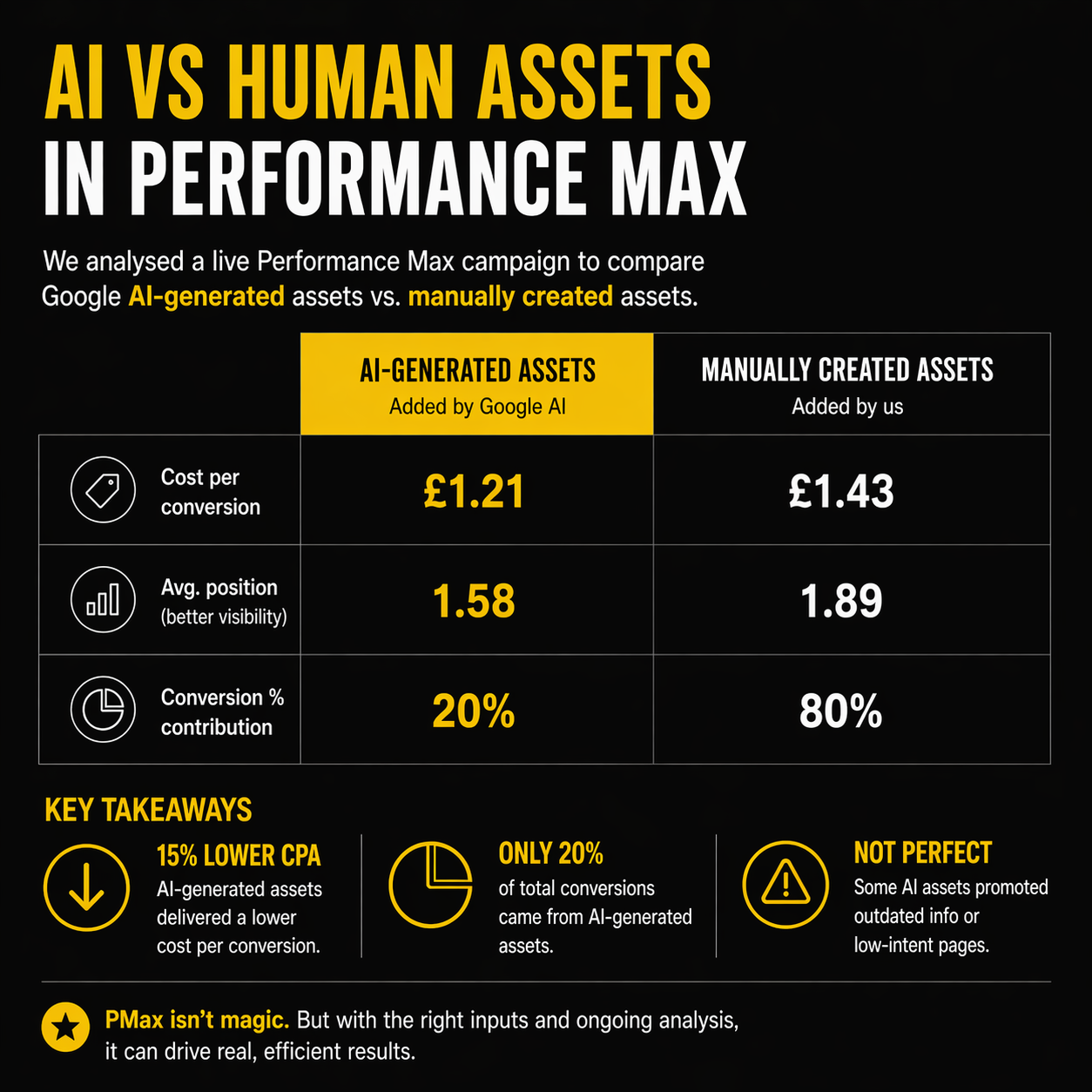
1. AI-generated assets were more efficient
AI-generated assets delivered a ~15% lower cost per conversion compared to manually created ones.
At first glance, this suggests that Google’s automation is outperforming manual input.
2. But they drove a minority of conversions
Despite the improved efficiency, AI-generated assets only accounted for ~20% of total conversions.
The remaining ~80% of conversions came from manually created assets.
3. Manual assets are still doing the heavy lifting
This shows that while AI improves efficiency, core performance is still driven by human strategy and creative.
What These Results Mean
Based on the data, Performance Max doesn’t appear to be replacing manual asset optimisation. Instead, it’s enhancing it.
There are a couple of likely factors at play:
Visibility uplift
Including AI-generated assets may provide a ranking or visibility advantage within Google’s ecosystem, helping improve overall campaign efficiency.
Incremental optimisation
AI is effective at:
- Testing combinations at scale
- Finding small performance gains
- Supporting your strongest assets
But it still relies heavily on the quality of what you feed into it.
Risks of AI-Generated Assets in Performance Max
While AI-generated assets showed some performance benefits, there were also clear issues.
We identified assets that were:
Poorly aligned with user intent
Some AI-generated content didn’t reflect the intent behind the campaign, leading to lower engagement and higher costs.
Factually incorrect
We saw examples where assets referenced:
- Outdated pricing
- Incorrect product details
For businesses where accuracy matters, this creates obvious risks.
Off-brand
Some assets didn’t align with tone, messaging, or positioning, potentially undermining brand trust.
This is a key conclusion: Performance Max is only as good as the inputs and oversight behind it.
Where Performance Max Works Best
Despite these observed limitations, Performance Max still plays an important role.
It works well when used to:
- Enhance existing campaigns, rather than replace them
- Scale performance once a strong foundation is in place
- Access newer placements, such as AI-driven search experiences (AI Mode, AI Overviews etc.)
With the continued growth of AI-driven search experiences such as AI Overviews, AI Mode and conversational search, AI-led campaign types like Performance Max are becoming increasingly important.
These latest ad formats are currently the only ones eligible to appear in these environments, making them a key part of any future proofing your advertising strategy.
For businesses with tighter budgets, niche audiences or geographic considerations, including many Jersey-based businesses, getting this balance right is particularly important.
Final Thoughts
Performance Max shouldn’t be used as a “set and forget” solution.
It won’t outperform a strong manual strategy on its own, but it can amplify one.
The most effective approach is:
- Strong manual foundations
- High-quality inputs
- Ongoing review and optimisation
- Strategic use of AI-generated assets
Looking to Improve Your Marketing Performance?
Whether you’re already using AI-driven campaigns like Performance Max, or exploring how they could fit into your strategy, we can help you get the most from your spend.
Get in touch via the form below to discuss your goals.
FAQs
What is Google Performance Max?
Performance Max is a Google Ads campaign type that uses AI to automate targeting, bidding, and ad creation across all Google channels.
Is Performance Max better than manual campaigns?
Not always. It can improve efficiency, but left to its own devices, performance will lag. A hybrid strategy of manually curated assets with managed AI generated assets is what will drive incremental performance improvements compared with traditional campaigns.
Should you use AI-generated assets in Google Ads?
Yes, but with oversight. They can improve performance but may also produce inaccurate or off-brand content. Therefore, a hands-on approach is needed to ensure your brand integrity is maintained, and you don’t put off your customers.
“@context”: “https://schema.org”,
“@type”: “FAQPage”,
“mainEntity”: [
{
“@type”: “Question”,
“name”: “What is Google Performance Max?”,
“acceptedAnswer”: {
“@type”: “Answer”,
“text”: “Performance Max is a Google Ads campaign type that uses AI to automate targeting, bidding, and ad creation across all Google channels.”
}
},
{
“@type”: “Question”,
“name”: “Is Performance Max better than manual campaigns?”,
“acceptedAnswer”: {
“@type”: “Answer”,
“text”: “Not always. It can improve efficiency, but left to its own devices, performance will lag. A hybrid strategy of manually curated assets with managed AI generated assets is what will drive incremental performance improvements compared with traditional campaigns.”
}
},
{
“@type”: “Question”,
“name”: “Should you use AI-generated assets in Google Ads?”,
“acceptedAnswer”: {
“@type”: “Answer”,
“text”: “Yes, but with oversight. They can improve performance but may also produce inaccurate or off-brand content. Therefore, a hands-on approach is needed to ensure your brand integrity is maintained and you do not put off your customers.”
}
}
]
}